
Six Appalachian State University students and two faculty members recently traveled to Belém, Brazil, to participate in the 30th Annual Conference of the Parties (COP30), gaining firsthand experience in global climate negotiations.
COP is the United Nations' primary decision-making body on climate change; it is a forum for representatives from member countries to set global climate goals and actions.
App State has been an official observer at the annual conference since 2021. The university is included among the RINGO — Research and Independent Non-Governmental Organizations — recognized by the convention.
App State student delegates
- Emily Charlip, MS Applied Data Analytics and MBA
- Sofie Crump, BS in Sustainable Development, Minor in General Business
- Grace Houle, BA in Environmental Economics and Policy, Minor in Sustainable Business
- Breana Meyer, BA in International Business, Minor in Spanish
- Tyler Nece, BA in Sustainable Development, Minor in Sustainable Business
- Alex Pecoraro, BA in International Economics, Minor in Political Science
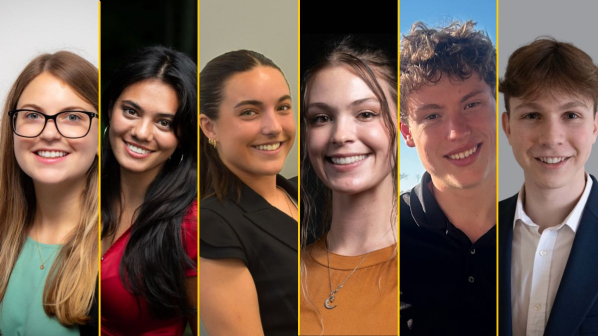
From left are Emily Charlip, Sofie Crump, Grace Houle, Breana Meyer, Tyler Nece, and Alex Pecoraro. Photos submitted
As part of the UN Climate Negotiations program at App State, the students prepared during the fall semester in the course ECO 4530/5530: UN Climate Negotiations, culminating in a capstone study-abroad opportunity to engage with the 197 participating countries in Brazil.
As observers to COP30 from November 12-15, the students had a front-row seat as representatives developed and negotiated policy, hosted events, gave press conferences, and presented exhibits to address climate change.
Student voices from COP30
The delegation shared their thoughts on Instagram, instagram.com/appstatetocop.
“We each follow different global climate initiatives, including energy efficiency, nature-based solutions, just transitions, emerging technologies, climate finance, adaptation, indigenous perspectives and voluntary carbon markets,” noted a delegate.
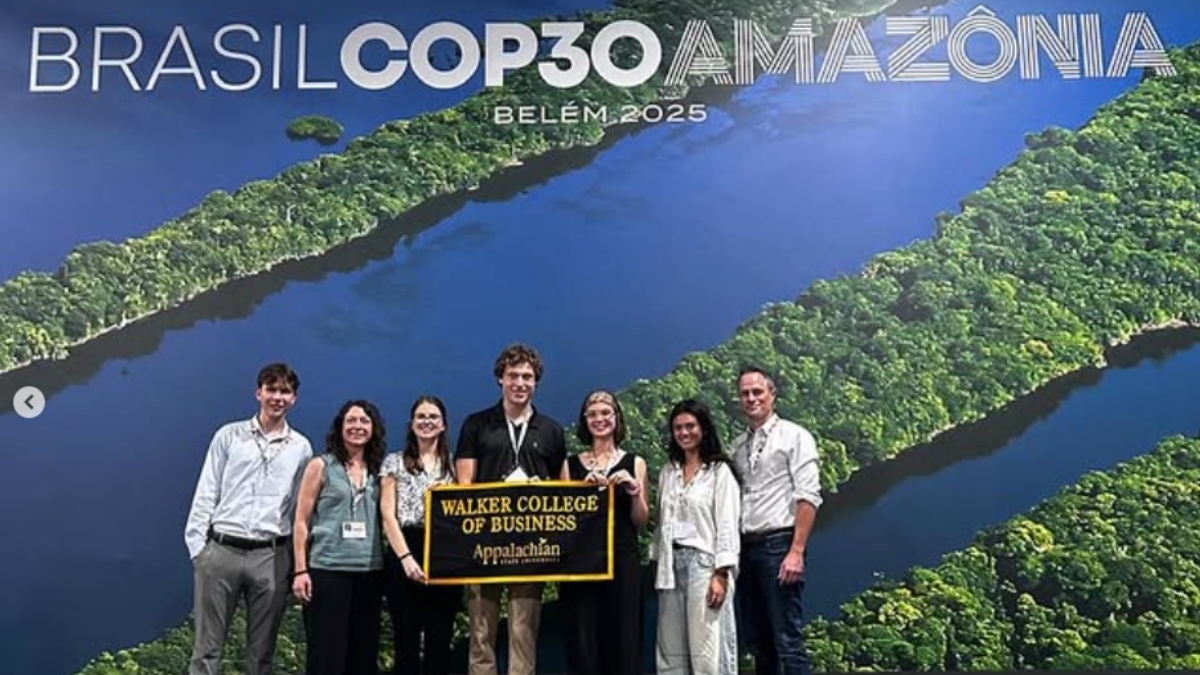
App State delegates at COP30 hold up a Walker College of Business banner. Photo submitted
The students spoke with Senator Sheldon Whitehouse (Rhode Island) and former US Climate Envoy Sue Biniaz. “The conversations were candid, frank and targeted,” noted a delegate. “The Senator was also very clear: the only way to reduce emissions at scale is to put a price on carbon and other greenhouse gases.”
“One of the coolest things about being at COP30 is seeing so many cultures sharing one space,” noted a delegate. “It really reminds you that the climate crisis has international implications and requires global cooperation on all fronts.”
Before COP30, the students visited the Tumbira Community along the Rio Negro near Manaus, learning about sustainable practices and the challenges posed by climate change to natural resources. “We learned so much about their way of life and the importance of natural resources — many threatened by climate change,” noted a delegate.
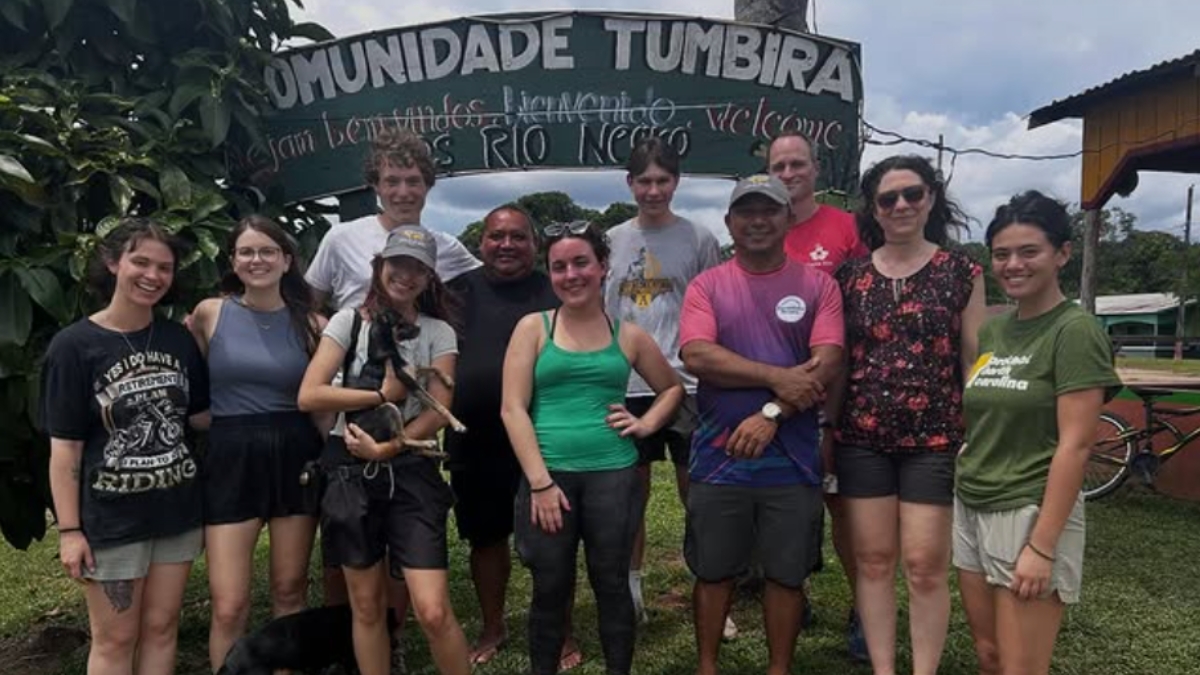
COP 30 delegates from App State visiting the Tumbira Community in the Brazilian Amazon. Photo submitted
Witnessing a protest of indigenous communities at COP30, one delegate noted, “They are frustrated because they both suffer from climate damages they didn’t cause, and they are forced into climate solutions that don’t fit.”
The students were accompanied by Dr. Dave McEvoy, chair of the Department of Economics, and Meredith Pipes, director of global engagement for the Walker College.
App State's UN Climate Negotiations program
Students are selected for App State's UN Climate Negotiations program through a competitive process. Interested students should contact Dr. McEvoy, mcevoydm@appstate.edu. Applications for the 2026 cohort with travel to COP31 in Turkey will open in April 2026. Find more information online, economics.appstate.edu/cop.
About Global Engagement in the Walker College of Business
The Walker College of Business encourages students to study abroad and provides a variety of short-term international programs designed to develop global business skills and intercultural knowledge. Learn more at business.appstate.edu/international.
About Sustainable Business at App State
The Walker College of Business teaches the theory and practice of sustainable business, recognizing that the economy, environment and society (the triple bottom line) are interconnected and interdependent, and strives to enhance the business model so that it can flourish and thrive to benefit future generations. The college offers a sustainable business minor available to business and non-business majors, a bachelor’s degree in environmental economics and policy, and MBA and MSADA concentrations in sustainability. The programs focus on student engagement, research, and community involvement. For more information, visit business.appstate.edu/sustain.
App State students and faculty with the COP30 sign in Brazil
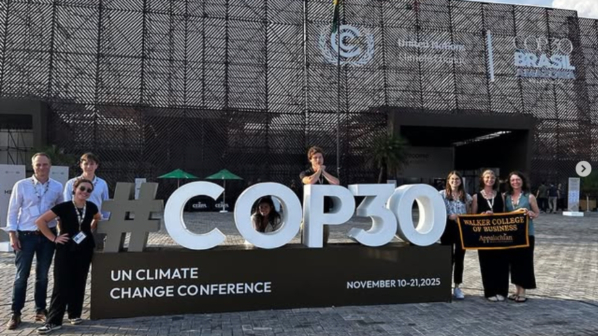
Photo submitted